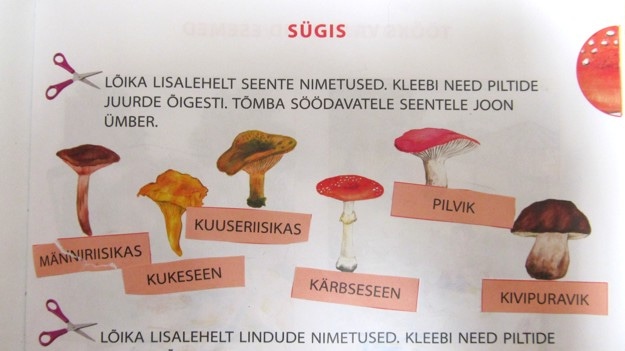
This is an exerpt from an Estonian grade 1 nature (loodus/teadus) workbook. The assignment, part of the chapter marked sügis (fall), was to cut out the names of the various seened (mushrooms) and match them with the correct picture. If 7 year-old first graders in Eesti can identify them, so should the rest of us.
Photo: Riina Kindlam
Starting from the left, the first is männi/riisikas. Mänd is pine and the riisika family of mushrooms is known as the Lactarius genus of mushroom-producing fungi, collectively known commonly as milk-caps and characterised by the fact that they exude a milky fluid called latex (piim/mahl) if cut or damaged.
Männiriisikas = Lactarius rufus, known by the common name rufous milkcap or red hot milk cap in North America. It’s dark brick red in colour, edible, and grows with pine or birch trees.
Wikipedia says: “Lactarius rufus is generally not recommended for consumption. However, it is used in some places as a condiment after special treatment, and mycologist David Arora notes that it is eaten in Scandinavian countries after canning, and also mentions that there may be edibility differences in North American and European versions of the mushroom.
In order to eat these mushrooms, you will have to cook them approximately 10 minutes in plenty of water.” The latter (parboiling) is called kupatamine and Estonians actually parboil these particular musrooms for half an hour. They are also pickled (hapendatud), salted (soolatud) and marineeritud; in other words the European variety of this seen is definitely picked and enjoyed.
Next is kuke/seen, literally “rooster mushroom” from its cock’s comb appearance, is commonly known in English as the chanterelle from its latin name Cantharellus cibarius. A beloved delikatess mushroom whereever collected and sold.
Kuuse/riisikas starts with the word kuusk (spruce). Lactarius deterrimus, also known as false saffron milkcap (same family as the first seen), produces medium-sized fruit bodies (mushrooms) with orange caps up to 12 vm (4.7 in) wide that develop green spots in old age or if injured.
Its orange-coloured latex (milky liquid) stains maroon within 30 minutes. This is a mycorrhizal (mükoriisa or seen/juur) fungus that associates with Norway spruce and bearberry. The species is distributed in Europe, but is also found in parts of Asia. Research has shown that the similar North American species from the United States and Mexico is not closely related to the European species.
Fourth from the left is the storybook classic kärbse/seen (“fly mushroom”), more specifically punane (red) kärbseseen or Amanita muscaria, commonly known as the fly agaric or fly amanita, a poisonous and psychoactive basidiomycete fungus, one of many in the genus Amanita.
It is native throughout the temperate and boreal regions of the Northern Hemisphere. Wikipedia: “Although it is generally considered poisonous (mürgine), there are few documented human deaths from its consumption, and after having been parboiled it is eaten as a food in parts of Europe, Asia, and North America.
Amanita muscaria is noted for its hallucinogenic properties, with its main psychoactive constituent being the compound muscimol. The mushroom was used as an intoxicant and entheogen by the peoples of Siberia, and has a religious significance in these cultures.
There has been much speculation on possible traditional use of this mushroom as an intoxicant in places other than Siberia, such as the Middle East, India, Eurasia, North America, and Scandinavia.” The name of the mushroom in many European languages is derived from its use as an insecticide when sprinkled in milk.
Pilvik contains the word pilv which means cloud and is known by its Latin name Russula in English. Around 750 worldwide species of mycorrhizal mushrooms compose the genus Russula, which means reddish.
They are typically common, fairly large, and brightly colored – making them one of the most recognizable genera among mycologists and mushroom collectors. For Estonians, these are well-known and valued edible mushrooms, although the 45 identified (or even up to 200 different) species of this mushroom found in Eesti can be grouped into mild-tasting, which can be consumed raw, slightly bitter, which must first be parboiled and thirdly those smelly, foul-tasting varieties not fit for consumption.
Last on the right is a kivi/puravik, with kivi mea-ning rock or stone. Boletus is a genus of mushroom comprising over 100 species; in Estonia 18 species of kivipuravik have been identified. The genus Boletus was originally broadly defined and described by Elias Magnus Fries in 1821, essentially containing all fungi with pores, (as opposed to gills, eos/lehekesed).
Wikipedia suggests: “The genus Boletus contains many members which are edible and tasty, not the least of which is the famed Boletus edulis.” — harilik kivipuravik. The flesh of many species of Boletus turns blue upon cutting and the Latin word Boletus means mushroom.
On Oct. 30th the Wall Street Journal posted an article and video on its website entitled “Where’s Your Mushroom Plot? Don’t Even Ask an Estonian. Fans Consider Private Haunts Sacred Ground” by Liis Kängsepp.
Look for it on the newspaper’s European edition homepage at www.europe.wsj.com by entering the search words “mushroom, Estonian”.
Riina Kindlam, Tallinn