Okupatsioonimuuseumi Vabamu noorteosakond ehk Noorte Vabamu kuulutas käesoleva aasta alguses välja konkursi “Minu Eesti”, mille käigus kutsuti Eestis ja mujal elavaid 15–25 aastasi eestlasi saatma nii eesti kui inglise keeles kirjutatud kirjalikke lühivorme, mis jagaks autorite kogemusi ja emotsioone seoses paigaga, mida me kutsume Eestiks.
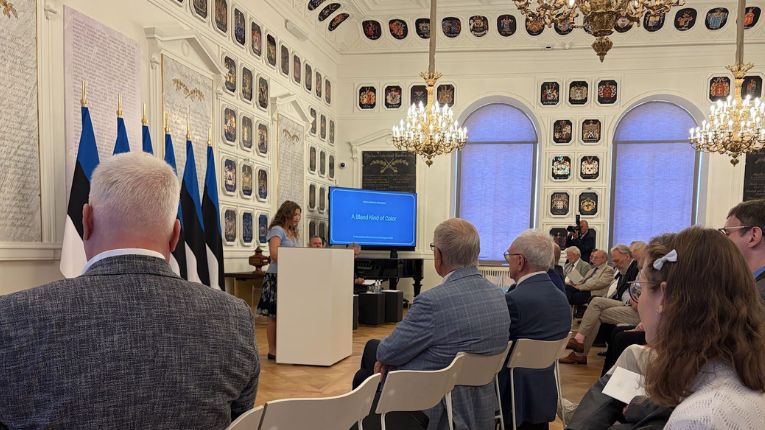
Võistluse võitis Ameerika Ühendriikides elav 18-aastane eestlane Nova Lambing-Grunberg. Ta sai 19. augustil 2026 oma ingliskeelset kirjatööd ka ette lugeda Tallinnas Rüütelkonna hoones toimunud 20. Augusti Klubi konverentsil “Parlament kui iseseisvuse taastaja ja hoidja”.
Kokku laekus 21 võistlustööd ning hindamiskomisjon valis nende seast välja 5 eestikeelset ja 2 ingliskeelset kirjatööd, kusjuures ühe eestikeelse luuletuse autor oli samuti Ameerika eesti noor, 18-aastane Kirke Triin Rajang New Jersey’st.
Minu Eesti
Kirke Triin Rajang, 18
New Jersey, USA
Väiksena oli mul häbi olla eestlane.
Ma tahtsin olla lihtne ameeriklane,
nagu kõik teised.
Aga enamus mu lapsepõlvest Ameerikas
on nagu udune pilt, mida ma ei suuda lõpuni teravaks tõmmata.
Mõned hetked tulevad tagasi
mitte rõõmuna,
vaid tunnetena.
Mu nimi oli teiste jaoks liiga võõras,
seda öeldi valesti, vahel naerdi üle ka.
Ja mina õppisin juba varakult nii,
et parem on jääda varju, mitte paista liiga siin.
Sõbrad ei tulnud lihtsalt,
teistel tundus see nii lihtne ja kindel alati.
Minul oli iga väike samm kui risk ja tee,
mida ma ei julgenud alati ettegi näha see.
Ka minu vanematel polnud Ameerikas kerge tee,
nad pidid alustama uuesti, algusest peale veel.
Raha ja kolimised olid pidev taust,
ja kodud ei jäänud kunagi kauaks paigale.
Ei jõudnud neist ükski päriselt koduks saada,
enne kui juba pidi jälle edasi ma rändama.
Ma olin ebakindel,
mitte sest minuga oleks midagi valesti,
vaid sest ma ei leidnud oma kohta,
kuhu kuuluda päriselt kasti.
Aga Eestis ootas mind pere ja päris kodu paik,
ja suved suvilas jäid mälestuseks, mis jäi vaid laik.
Laagris olid sõbrad, kes tundusid päris ja head,
naer ja keel, mis sidus meid ilma küsimata pead.
Nüüd ma mõistan selgelt, kui tagasi vaatan ma:
kõik, mida otsisin, oli kogu aeg minu sees juba
Ja ma sain aru, et ma ei pea end väiksemaks tegema,
ega varjama seda, kes ma olen, et teistele meeldima.
Eesti ajalugu on täis neid hetki ja lugusid nii,
kus meid on proovitud väiksemaks suruda siin.
Väiksemaks muuta, justkui poleks meil õigust siin püsida,
aga ometi oleme jäänud, keeldudes alla andmast ja alistuda.
Eestlane olla on haruldane ja päris,
meid on nii vähe, et iga side on tähtis.
Paljud mu elus Ameerikas ei teadnud, mis on Eesti,
see nimi oli võõras, tundus kauge ja selgita.
Aga ma räägin sellest nüüd uhkelt, ilma varjamata end,
sest Eesti on väike, aga südames suur ja kindel lend.
A Bland Kind of Color
Nova Lambing-Grunberg, 18
The potatoes collapsed under the weight of a fork, their skins slipping away like thin paper, steam blurring the kitchen window in soft gray spirals. Beside them sat a loaf of rye bread, dense and dark, a small country compressed into crust. On the table, a bowl of pickled beets gleamed, a sharp, living red among the browns and grays. This was the food of my childhood: heavy, quiet, unadorned. I thought it was something to apologize for. While my friends ate dinners bright with sauce and spice, ours seemed stuck in another century. Estonia’s food was simple, my mother told me, because it had to be. It was never meant to impress; it was meant to endure.
I used to think endurance was a dull word. But now I know there’s a kind of beauty in it, poetry inside the plainness. The foods of my childhood, the potato, rye bread, and pickled beets, are more than what they appear to be. They are small testaments to survival, to a country that learned to make meaning out of scarcity, and to a people who found nourishment in the act of holding on.
The potato, for instance, is a quiet kind of miracle. It grows where little else will, through cold soil, gray skies, and thin hope. My mother boiled them until they fell apart, their flesh breaking open to reveal a steam that smelled faintly of salt and earth. I thought they were bland. She thought they were home. During the Soviet occupation, when food lines stretched down streets and stores stood half-empty, the potato became less a food than a lifeline. Each one pulled from the ground was a promise that we could make it through another winter. It didn’t need to be beautiful, it needed to be enough.
As a child, I didn’t understand the reverence. I wanted flavor, not function. But now, when I taste a boiled potato, I understand why my mother smiled as she salted it. The simplicity was its strength. It was what sustained her when the world felt uncertain. It was the food of people who survived not by feasting, but by refusing to disappear. In that way, it reminds me of Amy Tan’s “Fish Cheeks,” where she describes her childhood shame over her family’s Chinese food and the wish to appear “American.” Like Tan, I used to feel embarrassed by the food that represented who I was, not realizing that the flavors I dismissed were carrying my family’s story forward.
If the potato represents sustenance, rye bread is the foundation. Thick, dark, and faintly bitter, it tastes like the soil itself, dense with history. My grandmother baked it by instinct, no measuring cups or written recipe. Her hands moved from habit; a technique learned long before I was born. When the oven opened, the smell filled the kitchen, and for a moment, even the walls seemed to exhale. I hated that smell when I was young, it made the house feel too small, too old. But that smell is what anchored us.
According to Visit Estonia, dark rye bread, known as must leib, is “an essential part of Estonian cuisine and a symbol of cultural identity,” something that links generations through shared history (“Estonia’s National Bread”). It’s the kind of bread that outlasts famine, that doesn’t crumble easily, that insists on being chewed. I’ve come to see that the bread’s heaviness mirrors the people who make it: resilient, unshowy, stubborn in their survival. When I eat it now, it tastes like memory, like a language I can’t quite speak but still understand.
The beets were always the outliers, bright and loud, the single flash of color in a meal otherwise muted. Their juice bled into everything, staining the plate red, as if reminding us that even survival has its small rebellions. Pickling was our way of keeping summer alive through months of darkness. My grandmother lined jars of beets and cabbage along a cold basement shelf, their glass bodies glowing faintly like captured sunlight. She would call it “Kindlustus talve vastu” (“insurance against the winter”) but I think it was more than that. It was a way of preserving joy, a bright, defiant memory bottled against scarcity.
Even now, that vinegar scent brings me back. It burns the nose, wakes the mouth, and refuses to let you forget its sharpness. When I eat pickled beets, I taste something both fragile and fierce. As chef Jenny Dorsey argues in her TEDx Talk “How Food Can Be a Source of Intimacy, Identity, and Vulnerability,” “what we eat, how we eat, and where we eat fundamentally shapes our identity”. I didn’t understand that until I realized that every Estonian meal was an act of remembrance, even the simplest of foods can hold centuries.
I think often about that idea of food as identity. In his TEDx talk “Food: A Third Culture Kid’s Sense of Identity,” Eric Pak reflects on how “the taste of home never really leaves you,” no matter where you go. His words echo in me. When I avoided my family’s food, I wasn’t just rejecting its flavors, I was pushing away the history it represented. I didn’t want to taste struggle, or scarcity, or the weight of what came before me. But in doing so, I also pushed away the strength that came with it. Relearning those tastes has become a kind of reclamation, a way to inherit endurance without shame.
There’s a quiet dignity in food that doesn’t try to impress. The potato, the rye bread, the pickled beet, each carries a story of persistence. They are not elegant, but they are honest. They taste of soil and vinegar and smoke, of effort and patience. For my ancestors, food wasn’t about art; it was about survival. And yet, I’ve come to see that survival itself is a kind of art—the art of making something out of nothing and calling it enough.
Now, when I sit down to eat, I think of my grandmother’s hands, red from beet juice, pressing dough into a pan. I think of my mother, humming quietly as she peeled potatoes, steam clouding her glasses. I think of how our meals always ended in silence, not because there was nothing to say, but because the food had already spoken.
When I think about the future, about the life I’m still shaping beyond these kitchens and these recipes, I imagine carrying these flavors with me. Maybe I won’t live in Estonia, or even speak the language fluently, but the food will follow me wherever I go. They will remind me that stories can be boiled, baked, or pickled and still last for generations.
Maybe that’s what food really is: a translation of history into the language of the body. When I taste these same flavors now, the earthy calm of potatoes, the bitter grounding of rye, the bright sting of beets—I taste more than ingredients. I taste resilience disguised as simplicity, the quiet strength of a people who built meaning from the barest materials. To eat what they ate is to understand them. It’s to taste the hands that planted, peeled, and preserved so that I could live in color again. Maybe survival isn’t just something we do, it’s something we pass on. And if the foods of my childhood have taught me anything, it’s that even the plainest meal can tell a story worth savoring.