The Joint Baltic American National Committee (JBANC) has continued its focus on helping to secure the Baltic region against Russian aggression and ensuring continued United States support for Ukraine. The advocacy centers on several key legislative and security priorities:
Security Assistance and Defense Funding
- Baltic Security Initiative (BSI): This is JBANC’s top priority. We welcome the inclusion of $200 million for the BSI in the Fiscal Year 2026 (FY26) Defense Appropriations Act to enhance the defensive capabilities of Estonia, Latvia, and Lithuania. However, the figure is lower than the FY25 level of $231.5 million. Previous years’ funding levels were at $228 million for FY24, $225 million for FY23, $180 million for FY22, and $169 million for FY21.
- Foreign Military Financing (FMF): JBANC has advocated for robust FMF levels, which totaled $15.75 million per Baltic country in FY25. We are working to ensure these funding levels remain consistent or increase in upcoming budgets.
- Deterrence Against Russia: Advocacy efforts emphasize the “race to establish credible deterrence,” noting that the Baltic states now commit over 5% of their GDP to defense for FY26.
Support for Ukraine
- Military Aid: JBANC remains a vocal supporter of continued U.S. military assistance to Ukraine, viewing it as essential to the security of the entire Transatlantic region.
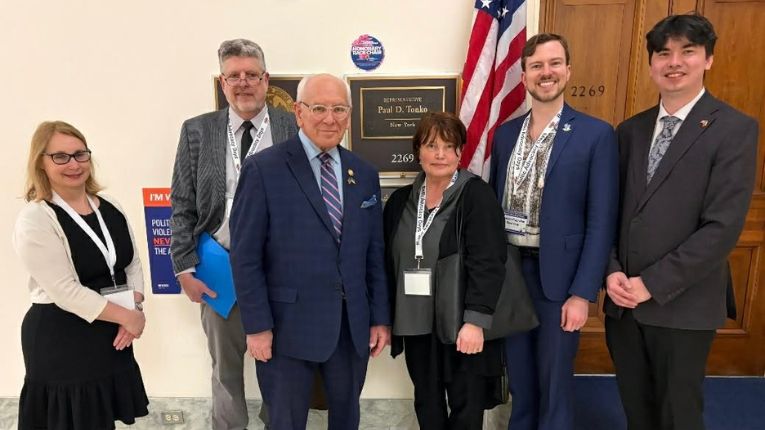
With this backdrop, JBANC organized its ninth Baltic Advocacy Days from March 16-18, known more familiarly as BAD. JBANC’s new Managing Director, Lee Allen, and his team organized what, subjectively, might have been the finest BAD yet. Ninety participants from nineteen states took part in advocacy meetings. While there were previous BADs with more states covered, the total number of advocates was the second highest ever. The 101 meetings held were a record. Beyond the meetings, the programming included briefings, three receptions, including at the Embassy of Lithuania, and great choir performances by the Baltimore-Washington Estonian Chorus, and the Washington DC-area Lithuanian choir Jorė. There were also an unprecedented number of younger Balts (particularly from the Lithuanian and Latvian communities) and friends of the Baltics who participated, including our Ukrainian friends.
The main priority of advocates was to garner support for the Baltic Security Initiative, a yearly appropriation, helping to build the defensive capabilities of the Baltic states and deepen the U.S.-Baltic security relationship. Advocates also communicated the need for sanctions on Russia and invited members to join the House and/or Senate Baltic Freedom Caucus.
The timing of BAD in mid-March allowed us to get ahead of the appropriations process. Importantly, BAD coincided with the issue of a March 20 letter sent by House Baltic Caucus co-chairs Representatives Don Bacon and Salud Carbajal, addressed to the Defense Appropriations Sub-committee leadership supporting the increase of funding to $300 million for the BSI for Fiscal Year 2027 (FY27). This year, the letter garnered an all-time high of 75 signatures of House members. We are grateful for the support of the members of the U.S. House of Representatives and the work of advocates during BAD, who encouraged their congressional members to sign onto this letter. There have been substantial increases in the four years that such letters have been issued (49 signatures in 2025, 33 in 2024, and 17 in 2023). The letter has served as an important guideline to the appropriations committee to underscore the importance of BSI and recognizes the commitment to a common defense from all three Baltic states, all “leading in defense expenditure nearing and exceeding 5% GDP in 2026.”
Raising funding to $300 million would help accelerate key defense capacity-building projects and bolster deterrence against Russian aggression. Continued investment is vital.

Another well-timed aspect of this year’s BAD was the introduction of the Baltic Security Assessment Act (S.4139) by Senate Baltic Freedom Caucus co-chairs Senators Richard Durbin and Chuck Grassley, and others on March 18. Thanks to BAD meetings and outreach, a few additional co-sponsors supported the bill, increasing the total to 19. The Senate bill compliments a House bill, H.R.5543, introduced in 2025 by Rep. Wesley Bell, and now with 74 cosponsors.
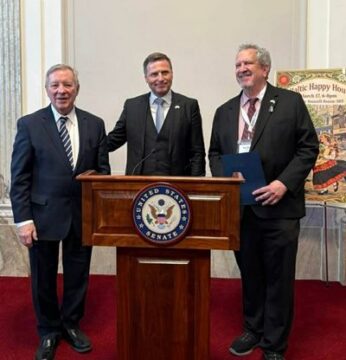
JBANC honored Senator Durbin with the Baltic Freedom Award for a lifetime of building U.S.-Baltic relations at the March 17 reception in the Russell Senate Office Building. The award was presented by JBANC Board member and Lithuanian American Council representative Thomas Sadauskas. We were joined by the Estonian Defense Minister, Hanno Pevkur, who greeted Sen. Durbin and presented JBANC’s Karl Altau with a letter signed by all three Baltic Foreign Ministers, thanking him for his work over the years. The reception also featured remarks from the ambassadors of Latvia and Lithuania, Elita Kuzma, and Gediminas Varvuolis, respectively.
Liepa Boberiene, director of the Baltimore Lithuanian School, and a participant at this year’s advocacy days, shared her motivation: “I simply wanted to honor a promise I made to myself as a girl: that I would do everything in my power to safeguard Lithuanian freedom, as best I can. When [JBANC] called for volunteers for Baltic Advocacy Days, I was eager to transform my anxiety into action.”

In walking the halls of Congress, you never know whom you’ll run into. As Boberiene continues: “As we emerged from a labyrinth of underground tunnels, we suddenly ran into [the Senior Senator from New Jersey, Cory Booker], who gave our merry band of Baltic advocates an uplifting cheer: ‘Nice work, Baltics!’ he shouted. ‘America needs to be more like you!’”
If you missed this year’s BAD, JBANC is planning a Virtual BAD in the autumn to follow up on some of these key initiatives.
Karl Altau, JBANC