In late 2021, I made a shocking discovery: My local Syrian baklava shop in Providence, Rhode Island had a Latvian Auseklis motif in its logo.
As a Latvian-Estonian-American, I had to investigate.
I walked into the store, ordered some baklava, and asked staff behind the counter: “What star is this?” I explained that the same type of eight-pointed star features prominently in Latvian folk designs. I said I had always considered it quintessentially — maybe even uniquely and specifically — Latvian.
They said they did not know the name of the motif, but that it was commonly seen in architecture around Damascus.
I left the shop feeling not entirely satisfied.
From that moment, at the back of my mind, I began a journey toward understanding the origins of the Auseklis motif, where else it occurs, and what it means for other cultures.
Over the following years, I started seeing my uniquely and specifically Latvian star everywhere. It appeared on Scandinavian textiles as the Selburose; in tatreez embroidery from the Levant, as the Moon of Bethlehem; in Moroccan tilework; on Lakota quilts as the Morning Star; and in a museum on an old wooden box from Persia.
I began to wonder: Did the same motif arise independently in each of these cultures, or was there a single, traceable origin from which it spread around the world?
My journey took an unexpected turn this September, when I read an article about the Muhu mänd.
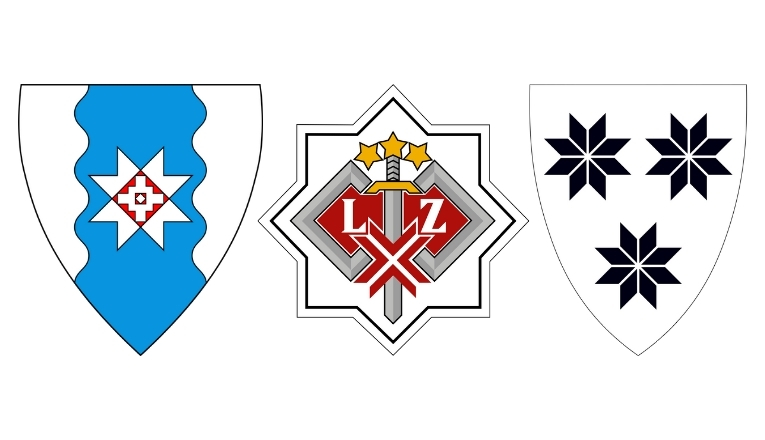
The Muhu mänd or kaheksakand is an eight-pointed star seen on the flag and coat of arms of Muhu Parish, a municipality on the island of Muhu in Estonia. The star also featured in a 2022-2023 exhibition at the MONA Museum of New Art in Pärnu.
I was amused to read that the people of Muhu may consider this motif to be their own invention — and to realize that, despite my having family roots in Muhu, their use of a Latvian motif escaped my attention for more than 30 years.
Upon learning about the Muhu mänd, I realized my journey in pursuit of this elusive eight-pointed star had gone full circle: from the Latvian heritage that I knew very well, to far-flung and unfamiliar places around the world, and back home again to Estonia.
Today the mystery of the Muhu mänd remains to be solved. Did the motif have a single origin or multiple origins? By what trade routes did it spread?
All of this may be known to scholars, but it is still unknown to me, and likely to many other Estonian, Latvian, and other casual folk-art enthusiasts around the world.
For now, at least, I can pause and appreciate the irony that so many of us turned out to be uniquely and specifically represented by the same cultural symbol.
Alessandra Suuberg
About the author: Alessandra Suuberg pursues non-partisan, cross-cultural dialogue through two independent projects: Decency LLC, which has a focus on healthcare, and Suuberg Arts LLC, which has a focus on arts and culture.
Citation: https://kultuur.err.ee/1608825313/mark-soosaar-las-muhulased-usuvad-et-nemad-leiutasid-kaheksakanna