
Last month I wrote about the benefits of oils and fats and the three different building blocks of oils, which determine whether an oil can be considered saturated and very stable (can be used for frying at high temperatures), mono-unsaturated or fairly stable (can be used for cooking, baking and sautéing at medium temperatures) and polyunsaturated or unstable (best used cold in dressings or sprinkled over cooked food when served).
Today we are going to look at the different processing methods of oils, low-fat and fat-free products and healthy fatty foods.
Processing of Oils
The highest-quality oils are called first cold pressed or extra virgin, and they are unheated, unrefined and sometimes even unfiltered. The name refers to a traditional method that is no longer widely used. Today, many commercially processed oils are “pressed” in a centrifuge. No heat is applied during extraction, so the initial process can still rightfully be called “cold pressed.” But in a second step, steam and solvents are used to extract more oil from the leftover pulp, producing an oil of inferior quality. In the case of olive oil, this may be called olive pomace oil or pure olive oil.
Generally, high pressure, heat and chemical solvents are used to squeeze the oil out of corn, grape seeds, safflower seeds and soybeans. Oils from these sources have high polyunsaturated fatty acid content, so they already become rancid in the manufacturing process. The rancid oils are then deodorized – with the help of more harmful chemicals – in order to be made palatable. To avoid this brew of rancid fats and harmful chemicals, stay completely away from refined corn, grapeseed, safflower and soybean oils.
Remember: If the label does not specifically state that an oil is unrefined, you may assume that it is refined and that the polyunsaturated fatty acids it contains are therefore compromised.
Polyunsaturated oils also come from sunflower seeds, walnuts, pumpkin seeds, sesame seeds and wheat germ. If you can find unrefined, cold pressed versions of these oils, feel free to use them cold in dressings or simply sprinkled over your cooked food once it is served. Buy flaxseed oil only if it is contained in an opaque dark bottle and was kept refrigerated until your purchase.
Hydrogenated Oils
There are hydrogenated oils, partially hydrogenated oils and trans fats. In essence, these are all the same thing. While hydrogenation is the manufacturing process, trans fats are the outcome. All hydrogenated and partially hydrogenated oils contain trans fats. Food companies wanted a cholesterol-free, easy-to-spread product with a long shelf life, so they began to promote margarine, a concoction made of hydrogenated oil. Partial hydrogenation is also used in some processed liquid vegetable oils.
Hydrogenation is a manufacturing process that uses high temperature and high pressure to force hydrogen gas into polyunsaturated fatty acids in order to solidify them. The hydrogen atom breaks into the double bond, takes out the bend and straightens out the fatty acid chain. The polyunsaturated fatty acid is thus transformed into a so-called trans-fat. Now it behaves more like a saturated fatty acid and packs together well to form a semisolid mass at room temperature.
But trans fats are biochemically incompatible with the human body. In fact, their chemical makeup resembles that of plastic. After hydrogenation, the original vegetable oil turns into a gray, ill-smelling mass. This mass then gets bleached and deodorized, again with the help of harmful chemicals. As a last step, a yellow dye is added to make the product appear more butter-like.
The human body is unable to metabolize trans fats. They remain in the bloodstream and are likely to collect on the artery walls as plaque, which can lead to heart disease. Other conditions associated with trans fats are Alzheimer’s disease, cancer, diabetes, obesity, liver dysfunction and infertility in women.
For decades, margarine has been touted as a health food, when it clearly is not. Today trans fats are in the news and have been recognized as a serious health hazard – in New York City, restaurants are prohibited from cooking with trans fats.
Low-Fat and Fat-Free Products
Many weight-conscious people are buying low-fat or fat free products. This might not be such a good idea. Whenever fat is manipulated, its quality becomes compromised. Because fat adds taste to a food, the fat in many of the low-fat or fat-free products is replaced with corn syrup to improve taste. For example, a low-fat fruit-flavored yogurt may contain ten teaspoons of high-fructose corn syrup in one serving! The calorie-saving effect of eating less fat is negated by the double-whammy effect of eating empty calories from corn syrup. When a food has little or no fat content, its sugars get released into our bloodstream even more quickly, and can lead to extreme blood sugar swings and accelerated weight gain.
Healthy Fatty Foods
In addition to the extracted fats and oils, there are plenty of foods that supply healthful fats.
Nuts and seeds and their butters (100 percent nuts or seeds ground), avocados and olives are good plant sources of healthful fats in the diet.
Dairy, eggs and meats are good sources as well. Whenever possible, use dairy, eggs and meats from grass-fed animals raised in a cage-free, free-range environment.
Cold-water fish such as salmon, trout, eel, mackerel, sardines and herring are good sources of healthful fats, especially omega-3 fatty acids. Omega-3 reduces the risk of cardiovascular disease and blood clots. It reduces blood pressure, cholesterol and plaque in the arteries.
Marika Blossfeldt
Author . Speaker . Coach
www.MarikaB.com
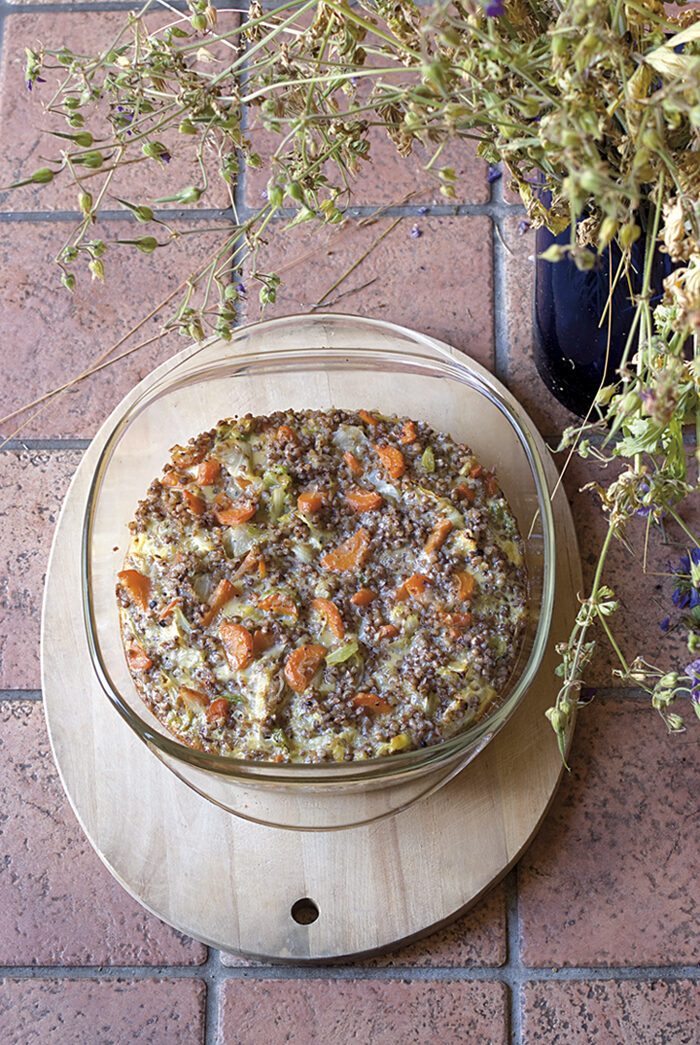
Kasha Casserole
Print RecipeIngredients
- 4 cups (960 ml) water
- 2 cups (480 ml) kasha (buckwheat)
- 1 tablespoon olive oil
- 4 pinches salt
- 4 onions, chopped
- 2 tablespoons olive oil
- 4 carrots, cut in half lengthwise, then sliced crosswise
- 1 medium white cabbage, chopped
- salt and pepper
- 10 eggs
- ½ cup (120 ml) milk
Instructions
Food Recipe Instructions
- Preheat the oven to 400°F (200°C).
- Bring the water to a boil. Add the kasha (never add kasha to cold water – it will turn out mushy), the tablespoon of oil and the 4 pinches of salt. Bring to a second boil, then reduce the heat to its lowest setting and simmer, covered and untouched, for 15 minutes or until all the water is absorbed.
- In a large pot, sauté the onions in the 2 tablespoons of oil for 5 minutes. Add the carrots, cabbage and a little water. Cover and simmer until the vegetables are tender, 5 to 10 minutes.
- Combine the cabbage mixture with the cooked kasha. Add salt and pepper to taste.
- Whisk together the eggs and milk. Pour over the kasha mixture and stir.
- Spread the kasha mixture in an oiled 8 x 12-inch (20 x 30-cm) baking dish.
- Bake for one hour or until the egg becomes firm.
Serve with sour cream and a tomato salad.

Food Recipe by Marika Blossfeldt (Published in Vaba Eesti Sõna)