By Lisa Trei
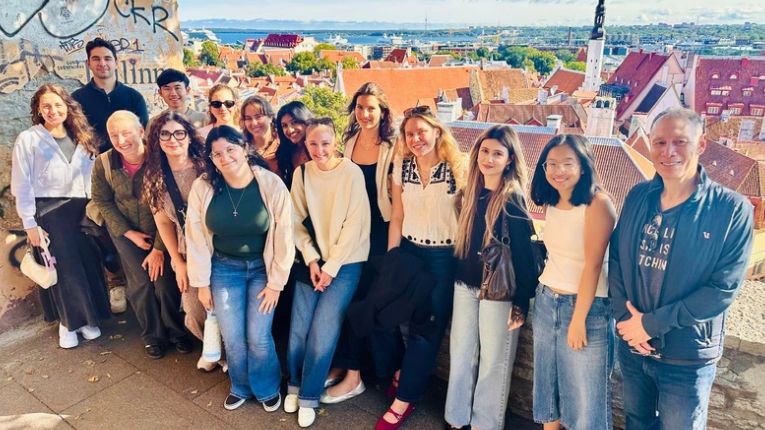
In a first-ever partnership between Stanford University’s Bing Overseas Studies Program and Vabamu Museum of Occupations and Freedom in Tallinn, 15 undergraduates visited Estonia and Latvia in September to learn about the region’s rich culture and history as well as the challenges it faces today.
“Freedom is Not Free: The History and Memory of Estonia and Latvia” was a three-week student program developed by Liisi Esse, curator for Estonian and Baltic Studies at Stanford Libraries, and Kadri Paju, Vabamu’s former international projects manager. Amir Weiner, Stanford associate professor of history, served as the faculty co-lead with Esse.
“Stanford’s Overseas Seminars offered our students a wonderful opportunity to get to know this region through discussions with local experts, while also visiting academic, governmental, and memory institutions,” Esse said. “We were pleased that we were able to organize such a seminar in the Baltic states for the first time, and we hope to be able to do so again in the future.”
According to Paju, the program was the culmination of years of close cooperation between Vabamu and Stanford University Libraries. Since 2016, Stanford has sent undergraduates to Estonia for summer internships. During their stays, Paju and Esse organize engagement programs for the students to help them explore the Baltic region further.
Since 2022, the Estonian Ministry of Foreign Affairs, in partnership with Vabamu, has reciprocated the exchange by sending scholars to Stanford for short-term research fellowships.
“We are delighted that Stanford’s Overseas Seminars Program supported our efforts to bring more students to the Baltic states,” Paju said. “It is important for Stanford students, as future leaders, to learn more about this part of the world through positive experiences and, hopefully, become informal ambassadors for Estonia and the rest of the Baltic region.”
Traveling from Tallinn to Narva, Tartu, and Riga, the group met leading scholars and experts in security, e-governance, education, and culture. Many of the speakers, such as Piret Ehin, professor of comparative politics at Tartu University, Marek Tamm, professor of cultural history at Tallinn University, and Merle Maigre, program director of Cybersecurity at Estonia’s e-Governance Academy, were former Stanford visiting scholars. Stanford alumni participants included Kristo Nurmis, an assistant history professor at Tallinn University, and Luukas Ilves, an AI advisor to the Estonian government.
Through lectures, films, tours, and informal dinner discussions, students explored the region’s complexity. They learned about the establishment of the Baltic states in 1918 and the first period of independence until 1940, the Soviet and Nazi occupations during World War II, and the subsequent Soviet occupation that ended only in 1991, when independence was restored. The group heard from experts about contemporary topics as well, such as e-governance, national security and defense, the war in Ukraine and its regional impact, political and economic developments in Latvia, and Chinese influence in the region.
The group toured the region’s leading history and art museums, and went on walking tours of Tallinn, Sillamäe, Narva, Tartu, and Riga. They visited Stenbock House, the seat of Estonia’s government, and climbed to the top of Narva Castle overlooking the border with Russia. In Latvia, they toured Riga Castle, the president’s official residence, and met with Baiba Braže, Latvia’s foreign minister, and Zanda Kalniņa-Lukaševica, deputy speaker of the Saeima parliament.
At the end of the program, the students wrote essays reflecting on what they had learned. Most had applied because they knew almost nothing about the region, and they remarked that the knowledge and experience gained would serve them well in the future.
“I can confidently say the three weeks I spent in the Baltics were the highlight of my year,” wrote Honor Warburg, a senior. “As a history student, I found it especially meaningful to learn about these countries’ histories where they happened. The resilience and pride of the Estonian and Latvian people left a lasting impression on me, and their commitment to preserving their memory and identity is deeply inspiring.”
Abby Copeland, a master’s student in public policy, wrote, “The Baltics Global Seminar program was one of the most academically transformative experiences of my undergraduate career. Through the incredible lectures, museum visits, and cultural experiences on the trip, I found myself evaluating and reevaluating the fundamental questions of how democracies come to be, what threatens them most, and, most vividly, what’s at stake if they’re lost. Every student, regardless of discipline, would learn tremendously from the Baltic story.”
The program’s success means that it may be repeated in a couple of years, Esse said. “In any case, Estonia and Latvia are happy to have 15 new young friends and ambassadors who understand the countries’ key topics and viewpoints,” she added.
Lisa Trei, a consultant at Vabamu, provided hands-on support during the program.