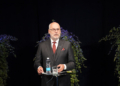
Helga Merits is an acclaimed historical documentary filmmaker. Her documentaries, including “The Refugee Children of Geislingen”, and “The Story of the Baltic University”, are important contributions to the body of research about the Estonian emigre experience. She grew up in the Netherlands as the daughter of an Estonian emigre father and Dutch mother, worked as a journalist in the Netherlands and Belgium, and is now a documentary film maker focused on the Baltic emigre experience.
Helga’s current project is about the post-World War II Estonian community in Seabrook NJ. In September she visited from Holland for two weeks for preliminary research in the Estonian Archives in Lakewood and the Cultural Center of Seabrook. For the next phase of the project she will be returning to the States in May 2020 to interview former and current Seabrook residents. “I’ll then be able to gather all of the final necessary information for the production of a film which will encompass all of the aspects of the Seabrook history.”
Helga Merits was afterwards interviewed by Tiina Vaska, Chairman of The Foundation for Estonian Arts and Letters (Eesti Kultuurifond Ameerika Ühendriikides).
The Foundation for Estonian Arts and Letters is honored to be one of your sponsors of the Seabrook project, and to support your recent trip in September, 2019 to the US to do research in Lakewood and visit Bridgeton, and Seabrook itself. Tell us about the trip.
It was thanks to Marilem Ferentinos, Valdis Basens and Indrek Ojamaa, who organised my stay in Seabrook, which started with a meet and greet in the museum and cultural centre of Seabrook, that my journey was very successful.
During the meet and greet, people of different communities told their stories and shared their thoughts about why their Seabrook years had been an important period in their lives, but also why the community of Seabrook, composed of so many different communities, was unique.
The barracks where people were housed are no longer there and the plant is no longer the same, as many things have changed over the years. But the memories are still there, as are the small villas, the church, the Buddhist temple, the school – and you can still feel, in a certain sense, how once the community, consisting of so many different communities, might have functioned.
I have recorded the first interviews and have an idea of the long journeys which brought people to Seabrook, about the losses, the longings and the shattered dreams, which were turned into hopes, ideals and new dreams. Hidden in the background of these memories was the story of the Seabrook family, a Greek tragedy, creating and destroying their own possibilities.
Why did you start making documentaries about Baltic refugees?
My father was Estonian and his life was determined by the war: being born in a certain year, he was forced to join the German army. He fled the country in the autumn of 1944 and ended up in a refugee camp in Germany. Like so many others at the time, he had tuberculosis and having poor health, he died at a young age.
As I was raised in Holland and learned about the war in a kind of black and white way, I found it hard to understand why my father had ended up in the German army. Why had he not run away, why had he not gone into hiding? I started to correspond with people of his generation to hear their stories and try to get a better understanding. Then I wanted to see if I could make these stories visual, by adding, most of all, historical footage.
The Estonian ambassador at the time in Holland, Gita Kalmet, very much encouraged me to make the documentary, as there were still many misunderstandings concerning the role of Estonia during World War Two.
So first of all, I was trying to learn more about my own background, but while doing research I found out about other stories. This way I learned about the Baltic University which was such a unique story that I was really surprised to learn there was no documentary about it yet.
I had already heard about Geislingen through my research for the “Class of 1943”. In this sense it feels for me somehow like a trilogy: as both Baltic University and Geislingen are mentioned in this film – though I didn’t know at the time I would actually make a film about both subjects.
Of the many Estonian émigré communities in the world, how did you happen to choose Seabrook, NJ as your current project?
In the Geislingen film, Thomas Vaga briefly mentions about Seabrook Farms, as the Lutheran Church had offered this as an opportunity to his mother to leave Geislingen and start a new life in the US, but I didn’t know much more.
When “Coming home soon – the refugee children of Geislingen” was screened at the Baltic Film Festival in Boston, I had a talk afterwards with a group of people who all had lived at Seabrook Farms. The stories they told about Seabrook were intriguing and made me wonder: how did this community function? I almost decided on the spot: this is interesting, and I would like to make a film about it.
A previous article in VES (8-15-2019) describes your quest for personal stories and mementos, but also posts several interesting questions to those that lived there regarding the broader Seabrook experience such as – what was it like to live in a community with multiple nationalities. What are some of those other questions that you would like to explore?
When the Estonian and Latvian refugees came to Seabrook, the living conditions were rather depressing and the working conditions very hard. They had survived war, flight, had lived in refugee camps in Germany for four to five years and now they had to build a new life again in difficult circumstances. How did the parents remain hopeful? How did they avoid getting depressed? Though there was no other option than to go on, look forward, be brave, as there was no way back, there were perhaps other aspects in their lives which might have helped them.
Most people had left their families behind in Estonia – parents, uncles, aunts, people who were older, people you could perhaps rely on for advice, or help, were not there. So, I think the community, with all the activities they organised to get people involved, played an important role.
Relating to this topic is the idea of resilience, meaning the capacity to recover from difficult circumstances. I would like to get to know if and if so, how this worked within the Estonian and Latvian community at Seabrook, because I think this is something that the parents passed on to their children and gave them, despite all the losses the parents had to deal with, a more positive outlook to the future.
The subject of resilience is – I think – an important subject, because there are so many refugees now. What are the circumstances that might create a positive attitude to overcome the traumas of war?
At the same time, it is a topic which concerns all of us: because it is an ability to go on and make something of one’s life.
Your documentaries are providing us, the émigré Estonian community, and Estonia with an invaluable documentation of our history. How can we help you with this project? I imagine both archival information and monetary support would be helpful in the production of this documentary.
I’m very interested in diaries, or letters, notes, or other documents written at the time, as I would like to give the parents a voice in the film as well. Pictures of the early years in Seabrook, film material and recordings of songs would be most helpful.
I’m very grateful that The Foundation for Estonian Arts and Letters made my travel to Seabrook Farms possible and The Estonian American National Council made it possible to hire a cameraman as well, so I could start with research and record the first interviews. This initial research is very important because then it will be possible to actually show some material to other people and have a chance to make clear why it is interesting and important to make this documentary. This way I hope to obtain more financial support, because filmmaking is relatively expensive since many people are involved in making it and as it will take one and a half, or perhaps two years to complete it.
I have an e-mail address for those who would like to contact me: [email protected] and my postal address is: Tollensstraat 62, 1053 RW Amsterdam, Holland.
Helga Merits