My daughter is four months old. She can’t ask me what “Estonian” means yet, but when she does, I want to have an answer.
I’m 35, American-born with pure Estonian blood. My grandparents fled Soviet occupation in the ’30s and ’40s, leaving behind everything except their language, their culture, and their unbreakable spirit. I grew up listening to stories of a homeland I’d never known but somehow felt in my bones. I remember how my grandfather’s eyes would light up when he spoke about his upbringing in Eesti and how proud he was to hear and sing eesti laulud, especially “Saa vabaks, Eesti meri.” Fortunately, Eesti sai vabaks. My grandparents grew up when transition and instability were the norm. They had to pick up and leave to preserve some semblance of their lives.
Four going on five generations later, those communities still carry on — smaller, quieter, but still here. Some people care enough to keep showing up.
Now I’m married to an American wife who doesn’t know her own roots, raising a half-Estonian daughter. If I don’t hold these roots now, who will?
Why This Matters Now
Väikesed rahvad ei kao kunagi.
The world has shifted. Russia invaded Ukraine. The US questions NATO commitments for the first time since WWII, while Estonia has played a very active role in shaping EU defense policy. The stakes for smaller, European nations like Estonia and Finland haven’t been this high in decades.
I understand why many Americans want to step back: focus on home, preserve strength, keep an eye on China. But when your grandparents fled this exact threat, when you have family and friends bordering Russia, every news alert from the Baltics hits differently. It’s not just geopolitics, it’s your people.
But this isn’t only about war. It’s about whether your wife will ever understand why certain friendships run blood-deep, why you trust people whose grandparents knew yours in the old country. It’s about whether your daughter will grasp the language her great-grandparents risked everything to preserve and whether she’ll carry it forward, or let it die with me.
What Being Estonian Means to Me
Kes ei loe oma rahva lugu, see kaotab oma juured.
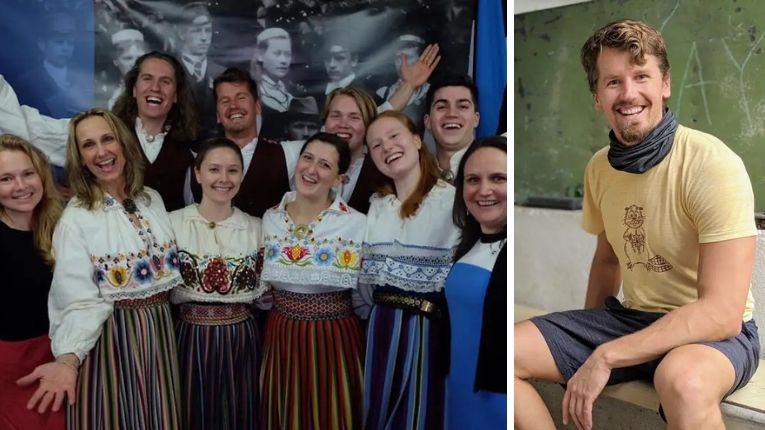
Growing up Estonian-American meant growing up in a village. A tight-knit community bound by shared persecution, shared culture, and shared determination. Estonians are small in number, but we’re a proud bunch.
We had to be. Multiple empires tried to break us, Russify us, erase us. They failed because we held onto what mattered: language, culture, identity, community.
I went through eesti kool, eesti laagrid, eesti üritused. Saturday mornings in New York City, trudging to Estonian school while my American friends slept in. I hated it at first. Another keel to learn, another set of reeglid, another reminder I was different. But somewhere along the way, it clicked. Maybe it was the õpetaja, who made our ajalugu come alive, or the moment I could actually speak with my xiin his native tongue. Those Saturday mornings became pühad. Sacred. I learned that being erinev wasn’t a burden, it was a lens through which to see the world that most people don’t get.
Most of my friends aren’t Estonian, but most of my close friends are. The ones I’d drop everything for. The ones who’d do the same for me. That Nordic reserve – slow to warm up, fiercely loyal once you’re in – that’s in my bones.
And then there’s camp. Suvekodu in Long Island gave me my friend group, my band of brothers. It gave me everything: leadership, purpose, summers soaking up sun and culture. Bonfires to sit by. Saun to talk. Laulud to õppida. Rahvatants to tantsida. Sleeping in tared with friends on narivoodid.
It was my happy place. My favorite weeks growing up. I remember staying up too late as a kasvataja and rising at dawn to workout and swim — if you howl with the wolves, you rise with the roosters. I remember Lia Mai always saying “be chipper” and “pea meeles, eesti keeles.” I remember crushes. Climbing the vaher by the bassein. Rannasõidud where Americans thought we were strange — lapsed in speedos, our sini-must-valge flag flying proud. Pretending we couldn’t speak English to sneak onto rides at the water park, then perfecting the act years later at 16 to score an õlu at the baar.
We thought we were so clever. We probably weren’t. But we were our own.
I still bleed blue, black, and white. And I love being American too. These identities don’t compete — they complete each other. Being Estonian taught me resilience, community, the value of preserving what matters. Being American taught me optimism, opportunity, the freedom to choose who I want to be.
I want this for my daughter. Not the exact same memories (she’ll make her own), but the same foundation. The same village. The same certainty that somewhere in this world, there’s a place where she belongs completely, where her roots run deep, where her children might one day climb their own vaher and feel the same inexplicable pull toward home.
What We’re Fighting For (And How)
Kus viga näed laita, seal tule ja aita.
This isn’t preservation for preservation’s sake. Here’s what I’m building for my daughter:
The Village. These friendships aren’t social, they’re survival. When the world feels unstable, you need people you trust without question. I’ll live and die with and for these people. Show up. It gives back tenfold.
The Place. Estonia itself – not as heritage tourism, but as living connection. A reset from American chaos. Estonia is peace, simplicity, and roots. Air that feels crisper. Nature untapped. Soil that feels right beneath my toes. I want my daughter to have friends there. To experience how knowing the language opens doorways into a different psyche. To fall in love with unkempt nature. To walk through pine forests onto empty beaches. To feel peace in solitude and know she has a lens most people don’t get.
The Language and Culture. This is the core. I speak to my daughter first thing in the morning and last thing at night in Estonian. My wife and I maintain a simple daily practice. My wife’s goal: speak better than my mother. Mine: speak better than my father. That would reverse the decline. We’ll reinforce through eesti kool, eesti laagrid, and annual trips to Eesti itself.
The real secret though? Friends.
If she has close friends who speak natively—whether in Eesti or here playing in eesti keel — her fluency shoots up tenfold. The desire to hold on has to be intrinsic. That’s the clear differentiator I’ve seen growing up: who held on and who didn’t came down to how much it mattered, how disciplined they were, and how much they leaned on the community.
You can’t force language on a child. But you can immerse them and let curiosity lead.
The Bridge I’m Building
Üks põlv läheb, teine tuleb.
I’m the bridge between my grandparents who fled and my daughter who will inherit what I preserve. My wife doesn’t have roots like this, which makes it all the more crucial that I tend to mine, so our daughter can choose to claim them.
Being Estonian taught me that small doesn’t mean weak. That survival means holding tight to what makes you you, even when powerful forces try to erase it. That a language, a culture, a community can outlast empires if you refuse to let them die. I learned this at my grandparents’ table. In eesti kool on Saturday mornings. At laager, in saunad, around bonfires, in friendships that shaped me.
I want my daughter to love her juured — her roots. To say it’s one of her lemmik parts of her identity. To rääkida eesti keelt better than I can, to have more ühendused in Eesti than I do. Kui ta tunneb, et see on tema teine kodu — if she feels it’s her second home, kus ta saab vabalt elada — where she can live freely.
When I’m gone, I hope she remembers how much our eesti juured meant to her Papa. When things get difficult, I want her to lean on this kogukond — this community. These are Your People. The ones who will be there for you when you’re there for them.
This is what I want my daughter to know: You come from people who refused to break. Who preserved keel, kultuur ja kogukond through the Suur Põgenemine. Who built külad in foreign lands and kept their souls intact. Who sat around kitchen tables telling stories so their grandchildren would never forget. Who still hold their eesti keel, laulud ja toit so dear.
You’re American, yes. And you’re a part of something older, smaller and more anti-fragile than most people can imagine.
That’s worth holding onto. That’s worth fighting for.
Magnus Skonberg