Tiina Ann Kirss
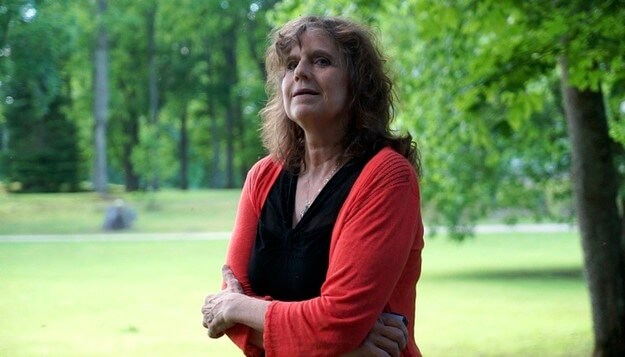
Tiina Ann Kirss. Source: Ly Lestberg / ERR
Literary scholar Tiina Ann Kirss writes about her family, who were among the 75,000 Estonians who fled in 1944, to mark the unveiling of a new monument to those known as boat refugees on the Puise Peninsula, Lääne County.
Standing here on the Puise Cape as the child of two people who escaped Estonia in 1944, first of all, I realize that my parents did not escape to Sweden with the help of experienced ship captains in September of 1944.
They decided separately – as they met a few years later – to escape to the west on retreating German vessels in a tense situation where a half hour’s delay could have meant the window of opportunity closing.
The decision proved fateful for my mother.
As a nurse or a nurse-midwife to use the term of the time, she could as an exception bring along her father, mother, brother and his fiance on board the overcrowded German infirmary ship Moero.
The ship took to the roadstead in the evening of September 21, 1944, departing for Gotenhafen the next morning.
It took a direct hit from a torpedo. Moero sunk in just seven minutes beneath calm seas on a sunny day at 11 a.m. on September 22.
It was never agreed how many people escaped with their lives.
The only thing that is certain is that it was just a fraction of the people on board, as wounded soldiers could not move quickly.
It is common knowledge that those who clawed their way onto the deck, the “upper stories” of the ship, had a greater chance of survival.
Instinct, alarm bells and courage, perhaps courage while holding someone’s hand.
Some survivors recall how a man and a woman jumped, each holding a small child in their arms.
When they surfaced, one of the children was gone.
The parents looked for their child at the Gotenhafen morgue.
My mother escaped with her life.
September days from my childhood only come to me vaguely, while I remember them as being sunny.
When I first heard the story of Moero from my mother, it was not in the language of numbers.
Indeed, it was not the main thing.
My mother held in her hand a waterlogged and washed-out piece of a watch strap.
The watch had stopped the moment she jumped at 11 a.m. on September 22.
My mother had witnessed her loved ones’ (inevitable or intentional) drowning.
It is likely they had found the courage to jump in the water from the quickly sinking ship’s high bow.
The lifeboats were overcrowded.
My mother wrapped the line of the lifeboat around her hand and passed out.
When she came to, she was on board the next ship in the convoy, the Lappland.
She was given a brief ID with the captain’s seal upon their arrival in Gotenhafen.
Shock and hypothermia caused her to spend a few weeks in the hospital, unable to move before she was given work in southern Germany in late October 1944.
Members of her family sinking along with the ship torpedoed in the Liepaja corridor weighed heavy on my mother’s heart.
Even the ghastliest imagination could not have foreseen it.
There were so many ships torpedoed and sunk during the war that postwar historians in Europe only use numbers to refer to them – numbers of ships, not people who escaped.
Mother told me and my younger brother about her escape in a positive key, describing it as a lucky break.
A decade after she was pulled from the sea, the birth and upbringing of me and my brother became her purpose.
All survivors are brave, which is why it is needless to mention she was too.
At the same time, it was clear that underneath her positive demeanor lay an unconquerable sorrow.
It is likely that the hardest thing for her was to live with her guilt, the guilt of having survived: she died of a grueling disease while still young.
Our family had a second tale of escape. My father’s.
He had also realized that Russian forces were about to take Tallinn.
He was a bachelor who had recently obtained a degree in chemical engineering from the Tallinn University of Technology.
As his dissertation and expertise concerned oil shale, there was work for him during the German occupation.
He tutored students more than a few of whom escaped German mobilization every year.
He had run from the Russian army mobilization in July of 1941, him and three of his friends spending six weeks in the attic of an apartment building in Kopli until their beards reached down to their chests.
My father secured an official assignment to the Wittemberge chemical industry in September of 1944 and started cycling from Tallinn to Virtsu.
He was caught, his bicycle confiscated, while he was to be shot in the forest.
For some reason, it was decided to save the bullet and let my father live.
He continued on foot, boarded a ferry in Virtsu and hiked to the Tip of Sõrve Cape (on the island of Saaremaa – ed.).
He managed to catch a boat from there and made it to Germany a few days later.
His saga between Wittenberg and Berlin, how he crossed the Elbe and reached the Hamburg Zoo camp would be too long to tell.
My mother’s tale was tragic. My father got lucky.
Having spent years contemplating these events as they were relayed to me, I am certain that my parents were really escaping from the war: neither reaped special benefits nor did they have several boatloads of expensive furniture and belongings they could use to start a new life. Their only wealth was fear.
I learned to save money and to dedicate myself fully to learning, as education was sacred when I was a child.
One needed to learn a trade, become an engineer, lawyer or doctor. Alas, I became a humanitarian.
My parents maintained an Estonian home and values.
My father lived to a ripe old age and managed to pay a visit to his brother, who he had not seen for 52 years in 1992 and again in 1994.
My parents did not travel west in search of the “good life” nor did they betray Estonia.
They were refugees.
International refugee support organizations (the United Kingdom and UNRRA) saw to it that they were fed, sheltered and given work for almost six years.
That is when the emigration lottery began.
Compared to these days, both of my parents were very lucky.
No one set fire to their refugee camp.
Instead, a temporary Baltic University was established in the British zone that allowed a thousand Baltic students to continue their higher education and scholars to teach them.
That is where my parents met, at a chemistry workshop my father was teaching.
My mother was a medical school student.
I would not be alive without them, not to mention a permanent resident of Estonia.
I remember them.