
Fats and oils have been the subject of misunderstandings, misleading recommendations and hype for some time. The cholesterol scare has us thinking that animal fats are bad for us, that saturated fats are bad for us, that fat in general is bad for us. These claims are untrue. Many weight-conscious people fear fat for its high calorie count. However, the most serious health problem caused by fats and oils is from neither cholesterol nor calories – it is from rancidity and unnatural processing.
We do need some body fat to insulate us against the cold, to cushion our organs and hold them in place. We need to consume fat to be able to absorb the fat-soluble vitamins A, D, E and K prevalent in greens and other vegetables.
Can you see how a fat-free salad dressing does not do you any nutritional favors?
Fat plays an important role in the absorption of calcium and therefore in the maintenance of bone health. It is no coincidence that both milk and cold-water fish come with a fair amount of fat in them – both are good sources of calcium. So, fat-free or low-fat dairy products do not make much sense – we need the fat for effective absorption of the calcium contained in these foods.
Fat also nourishes our skin, hair and nails and is important for proper brain functioning, especially in the developing brains of babies and children. Too much fat in our food can clog up our lymphatic system and compromise our immune system. The right amount of fat, however, slows down the digestion process just enough to allow effective absorption of nutrients. By slowing the speed at which carbohydrates are broken down into sugars, fat helps to stabilize our blood sugar level, which in turn fosters weight loss.
Another way that fats can help rather than hinder weight loss is through their role in the endocrine system. Our brain reacts to fat intake by producing a chemical called cholecystokinin (CCK). CCK stimulates the liver to produce bile, which helps in the digestion of fat. CCK also gives us the message that we have had enough food – in essence, curbing our appetite. A bit of fat in the diet hastens a feeling of satiety and satisfaction with what we have eaten, thereby permitting us to save calories by eating no more than we need.
Our main concern when it comes to consuming fats and oils should be rancidity in processed oils. While spoilage in other foods is in some way apparent – think of rotten eggs, moldy fruit or even butter left out in the sun – spoilage in refined oil is insidious. We can’t readily detect it because the product has been deodorized. Some oils are more prone to rancidity than others. The deciding factor is the chemical makeup of a particular oil or fat.
Let’s look at the three kinds of oils and fats and how they behave in our bodies
The building blocks of oils and fats are called fatty acids. They come in three forms: saturated, monounsaturated and polyunsaturated.
The saturated fatty acids are straight chains of carbon atoms with two hydrogen atoms attached to each. Because of their straight shape, the chains pack together well and form a semisolid consistency at room temperature.
Butter, ghee (pure milk fat, also called clarified butter), lard (from pork), tallow (from beef), coconut oil and palm kernel oil contain a high percentage of saturated fatty acids. These are very stable and do not become rancid easily. They can be heated to high temperatures without a compromise in quality. They can be used for cooking, baking, sautéing, and except for butter, frying. Butter, because it is not pure fat, is not well suited for frying – its lactose and protein particles tend to burn and turn brown rapidly. Ghee, on the other hand, because it is pure milk fat, does work well for frying. For the same reason, ghee is suitable for people with lactose intolerance. But regular butter is fine when heated in gentler ways. It is an especially good complement for steamed vegetables – add some at the end of the cooking process to ensure absorption of fat-soluble vitamins and enhance taste.
The monounsaturated fatty acids have one double bond between two carbon atoms, leaving the two double-bonded atoms with only one hydrogen atom each and causing a bend in the chain. Because of this bend, monounsaturated fatty acids do not pack together as well as the saturated ones do. They become liquid at room temperature and remain solid only when refrigerated. Olive oil is the most commonly used oil that consists of mainly monounsaturated fatty acids, but almond, avocado, cashew, macadamia, peanut and canola (or rapeseed) oils are monounsaturated as well. These fatty acids are fairly stable and are therefore suited for cooking, baking and sautéing.
The polyunsaturated fatty acids have two or more double bonds – two or more bends in the chain – which means their molecular structure resembles a semicircle. They do not pack well together at all and are therefore liquid even when refrigerated. Common oils with high polyunsaturated fatty acid content are made from corn, flaxseeds, grape seeds, pumpkin seeds, safflower seeds, soybeans, sunflower seeds, walnuts, wheat germ and sesame seeds.
Rancidity is the main problem with all polyunsaturated fatty acids. Light, air and heat affect their freshness and quality. Therefore, oils containing predominantly polyunsaturated fatty acids should never be heated or used in cooking.
They can be used in cold dressings or sprinkled over cooked food when served. They should always be kept in the refrigerator.
Next month we will continue with the subject of oils and fats. You will learn about the processing of oils and how that affects the quality of an oil. You will also learn about fatty foods, and cholesterol.
Marika Blossfeldt
Author. Speaker. Coach.
Blissful Kundalini Yoga Vacation July 24 – 30
https://marikab.com/retreats/
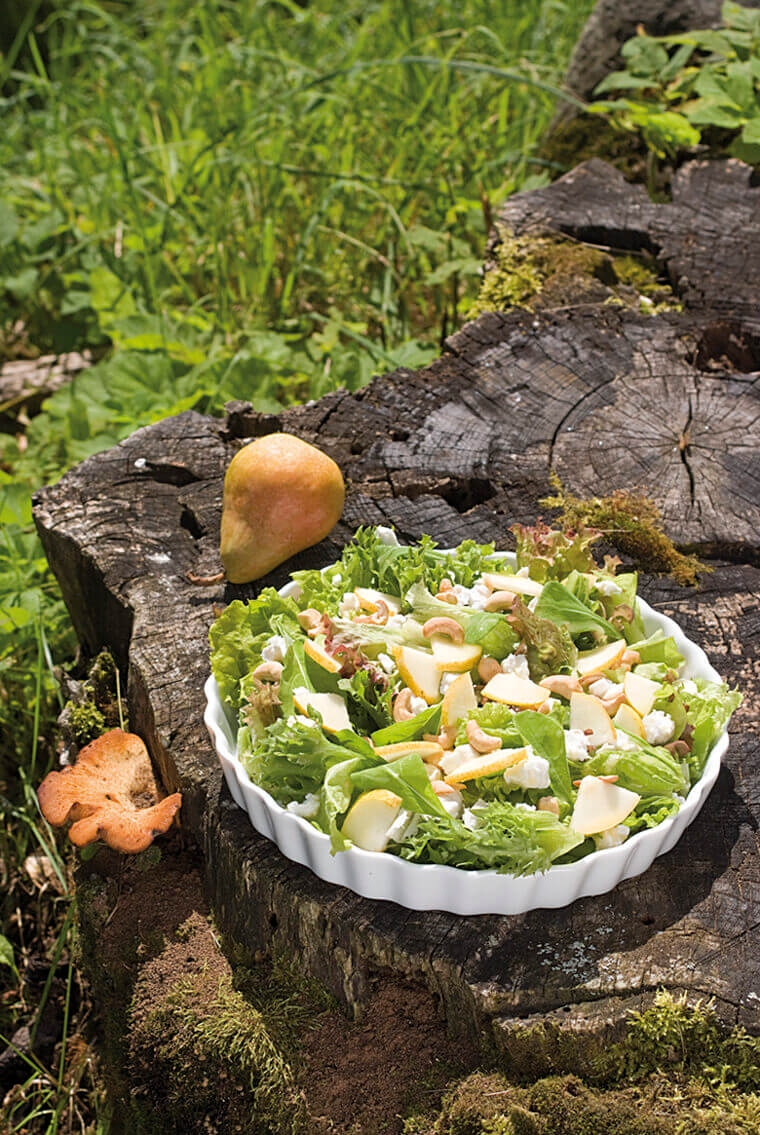
Green Salad with Goat Cheese, Cashews and Pears
Print RecipeIngredients
- ½ cup (120 ml) raw cashews
- 4 handfuls lettuce, different varieties including arugula
- 1 or 2 pears, quartered lengthwise, seeds removed, then cut crosswise into thin slices
- 4 ounces (115 g) soft goat cheese, cut into chunks
- ½ cup (120 ml) olive oil (DRESSING)
- ¼ cup (60 ml) lemon juice (DRESSING)
- 1 to 2 teaspoons prepared mustard (DRESSING)
- 1 to 2 teaspoons honey (DRESSING)
Instructions
Food Recipe Instructions:
- Preheat the oven to 400°F (200°C).
- Spread the cashews on a cookie sheet or in a baking dish and roast for 5 minutes or until light brown. Be careful not to burn the nuts – once you smell the aroma, they are done.
- Tear the lettuce into bite-size pieces and submerge in cold water. Move the lettuce around in the water to dislodge any soil or sand. Drain in a colander or use a salad spinner.
- Arrange the lettuce on a large platter. Add the pear slices and the cheese. Top with the roasted cashews.
- Place all dressing ingredients into a glass jar. Close the lid and shake to mix. Just before serving, pour the dressing evenly over the salad.
Serve with whole-wheat toast and butter.
Food Recipe by Marika Blossfeldt (Published in Vaba Eesti Sõna)