During the First World War, the Kingdom of Italy entered the war in 1915 and soon found itself faced with the dilemma of prisoners.
It was not the first time that prison camps had been set up, such as in Caserta, Campania, where Turks from the Libyan War were held. But now the problem was that enemy soldiers were far greater and came from all over Europe. The Austro-Hungarian Empire was composed of many peoples, but in Italy there were also Greeks, Russians, and Indians, allies who died of disease along with 45,000 of the 477,000 prisoners held in Italy from 1915 to 1922.
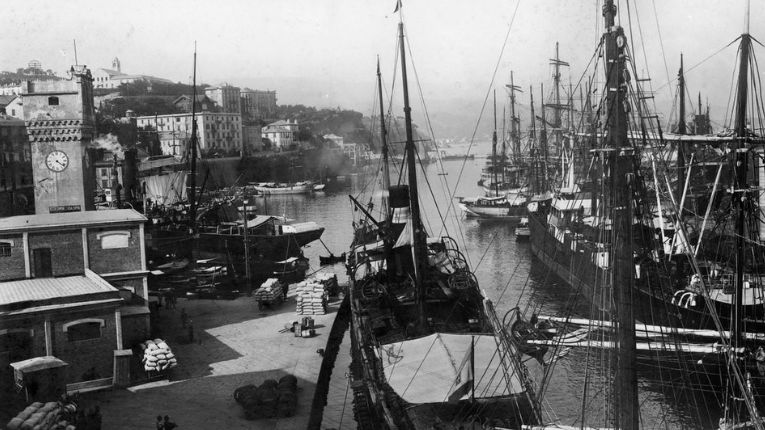
Among them was the Ukrainian Theodor Musak, born in Uzhhorod and died in Savona on October 21, 1918, in Villa Monturbano, then used as a military hospital. In this Ligurian city, several British soldiers who died at sea on June 4, 1917, as well as several Scandinavian sailors, were buried. One of them was Edvaar Kaar, a Russian stoker who drowned on April 15, 1917. His body was found ten days later. He was tall and blond, and, as the death certificate states, “had, however, the apparent appearance of a foreign sailor.” Comparing the young man’s face with a photo provided by an English captain (his superior and commander of the steamboat “Carventan”), the sailor’s identity was confirmed. He was a civilian who had died from causes unrelated to the ongoing conflict and thus was not included in the casualty count, and as a result, his personal details were often recorded incorrectly.
The surname Kaar was likely of Estonian or Finnish origin, and several subjects of the Russian Empire were native to the Baltics. So the search for this sailor’s identity began with an email to the Helsinki Maritime Museum in 2023. The curator’s kind response was that the surname was rare in Finland, and he suggested contacting Estonia. Despite these efforts, the conclusion was that there was little to be done without a date or place of birth.
An email to researcher Teele Saar of the Tallinn Maritime Museum was the last resort before giving up. She confirmed the sailor’s Estonian origins and also illustrated the situation at the time, when many young men left Estonia to work on foreign ships. Edvaar Kaar’s death certificate estimated his age at 25-30, but Ms Saar added that a boy aged 14-16 might seem older, given the demanding profession.
Finally, she suggested writing to Dr Peep Pillak, an Estonian historian, who identified the sailor in question as Eduard Kaar, a native of the island of Hiiumaa (born October 20, 1897), son of Jaan Kaar (born December 21, 1854) and Liso Tänavsuu (born September 24, 1857). Over time, Eduard was forgotten, and all trace of his grave in the town cemetery was lost. However, this article is dedicated to his memory, so that this young sailor from afar may be remembered.
My objective is to find any relatives, in case they went to the US.
In the Death Registry of Savona, Year 1917 Part II C, N42, in an entry on 22nd May 1917, an Italian official wrote that he received a document from authorities on the finding of a dead body on April 25th 1917 in the harbour belonging to a young, robust and tall man with blonde hair. Age probably 25-30 years old.
Apart from the description of clothes and a large varicose vein on his right leg, it was confirmed that no identification papers were found on the deceased. “Aveva però l’apparente aspetto di un marinaio straniero” (However his appearance resembled a foreign sailor), is the important statement.
It was recorded that on April 15th 1917, the “Russian” stoker Edvaar Kaar had disappeared from the British steamboat “Carventan” and the steamboat Captain left police a missing persons report with a photo of sailor Kaar.
The body had some signs of decomposition and the face was a bit mutated but the dead body was photographed and it was confirmed with a comparison of the two pictures, that this body belonged to Edvaar Kaar. There were no signs of violence, excluding a homicide, so he most likely accidentally fell in the water and died from drowning.
Matteo D’Angella is an Italian university student with a passion for history in his spare time and he can be contacted by email at [email protected]
Matteo D’Angella